PATIENTPROVIDER
Provider — Patient Outcomes

Patients understand more of the conversation with Earlens

Earlens is designed to restore more of the natural range of audibility than any acoustic hearing aid

Patient outcomes
Just as with any hearing solution, patients may need some time to adjust to the new way that they are hearing. Some patients prefer to ease into their prescribed high frequency gain with the Earlens acclimatization program. Others immediately adapt to the prescribed high frequency gain without additional adjustments.
82% of participants in a study indicated they reported they spent less listening effort with Earlens compared to their acoustic hearing aid
Evidence-Based

Clinically Proven Benefits

Broad Spectrum Amplification Preferred

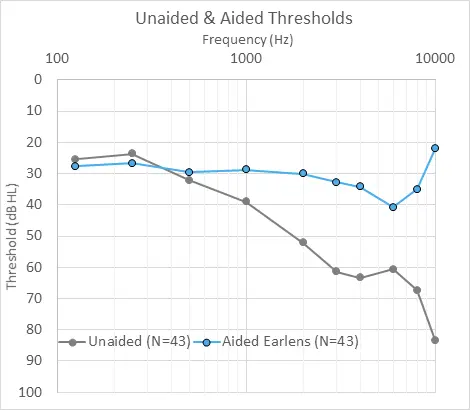
Clinical studies have confirmed functional audibility of speech sounds achieved with the Earlens Contact Hearing Solution through 10 kHz while functional audibility is limited to ~5 kHz with conventional acoustic amplification (Struck and Prusick, 20171; McElveen et al., COSM, 20172; Arbogast et al., 20183). Preference data is positive for the sound quality of the broad spectrum amplification provided by the Earlens Contact Hearing Solution over participant’s prior acoustic aids in multiple listening categories including listening in noise, music, and group conversations (Arbogast et al., 20183).
Struck and Prusick, 2017McElveen et al., COSM 2017Arbogast et al., 2018
Broad spectrum amplification chart

Unparalleled Streaming Sound Quality

The Earlens Contact Hearing Solution’s unique mechanism of action allows for the provision of low-frequency output for streamed sources while maintaining a widely vented fitting. Using the Multiple Stimuli with Hidden Reference and Anchor (MUSHRA) industry-wide standard method for evaluation of sound quality, subjective judgments of streamed audio quality of the Earlens compared with open-fit MFi-capable acoustic hearing aids revealed that Earlens offers the best streamed audio sound quality for speech and music in subjects with normal and impaired hearing (Eskridge et al., AAA 20196).
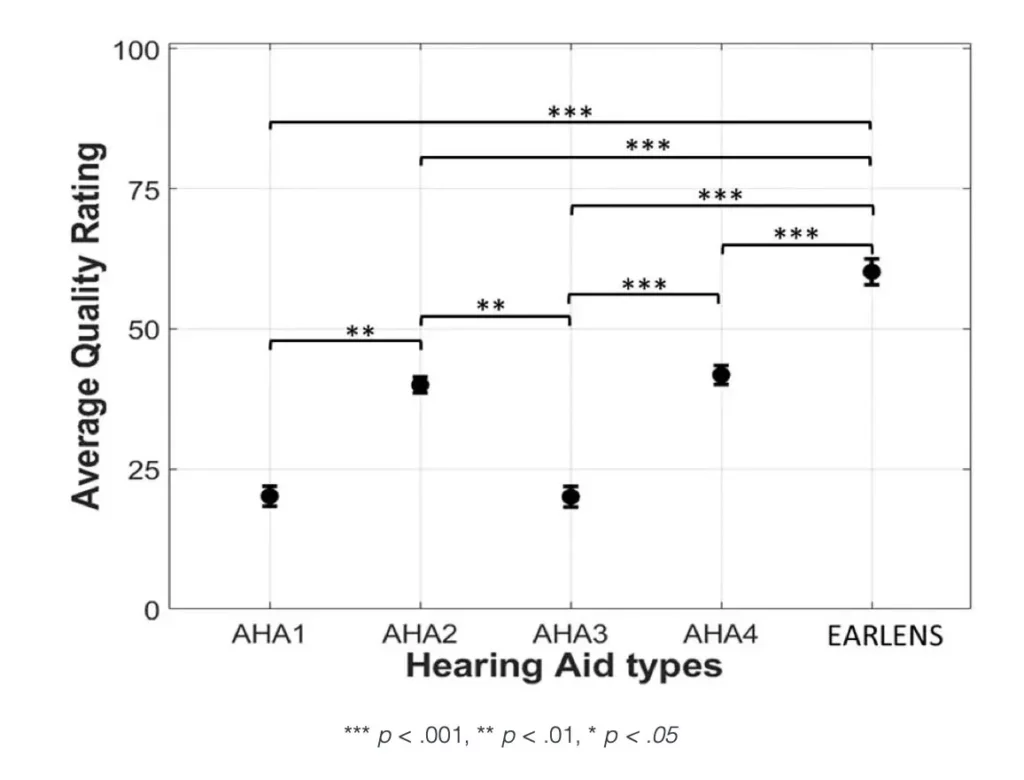
Hearing aid types comparison

Clinical Safety

Fay et al. (2013) published initial Earlens clinical results demonstrating safety, technical feasibility, and patient improvement of direct-drive technology. Gantz et al. (2016) demonstrated hearing stability was maintained after lens wear. Earlens continues monitoring device safety.

Fay et al., 2013Gantz et al., 2016
From the Field

Hear From Providers

This is the only technology that I offer where patients routinely cry tears of joy when we activate them. So it's very gratifying for me to be able to offer something like this to my patients.

Earlens allows patients to get the best possible return in their investment for their hearing health. They're going to get the best devices, recurrent efforts to make their devices maximize their performance and that results in better outcomes that my patients are thrilled with.

Earlens has changed my world for the better.

References
  1. McElveen J, et al. Overcoming High-Frequency Limitations of Air Conduction Hearing Devices Using a Light-Driven Contact Hearing Aid. COSM, 2017.
  2. Struck CJ, Prusick L. Comparison of real-world bandwidth in hearing aids vs Earlens Light-driven Hearing Aid system. Hearing Review. 2017;24(3):24-29.
  3. Arbogast TL, et al. Achieved Gain and Subjective Outcomes for a Wide-Bandwidth Contact Hearing Aid Fitted Using CAM2. Ear Hear. 2019;40:741-756.
  4. Levy SC, et al. Extended high-frequency bandwidth improves speech reception in the presence of spatially separated masking speech. Ear Hear. 2015;36:e214-e224.
  5. Street L, et al. Extended High Frequency Amplification through 10 kHz Improves Speech Understanding. American Auditory Society, 2017.
  6. Eskridge-Mitchell E, et al. Sound Quality Comparison of Streamed Audio Through MFi-Compatible Acoustic Aids and a Contact Hearing Aid. AAA 2019.
  7. Fay JP, et al. Preliminary evaluation of a light-based contact hearing device for the hearing impaired. Otol Neurotol. 2013;34:912-921.
  8. Gantz BJ, et al. Light-driven contact hearing aid for broad-spectrum amplification: Safety and effectiveness pivotal study. Otol Neurotol. 2017;38(3):352-359.

A Revolution in Hearing Technology

Earlens is designed to restore more of the natural range of audibility than any acoustic hearing aid

Discover the Difference with Earlens